
Business & commercial
Is commercial solar worth it? Payback, ROI and what changes them
How to tell if solar pays off for your business: self-consumption, worked payback examples, NPV and IRR in plain English, and when it is not worth it.

Commercial solar · Offices
The short answer
A typical office runs on weekdays from around 8am to 6pm. The main loads are air conditioning, lighting, computers and, in larger buildings, lifts and ventilation. Air conditioning follows the weather: it works hardest on hot afternoons when solar is also at full output, which is a good match.
Outside working hours the load drops to baseload: servers, security, emergency lighting, standby equipment and some ventilation. Weekends are the biggest gap. A system that is sized too big will export most of what it makes on Saturday and Sunday, and exports usually pay little.
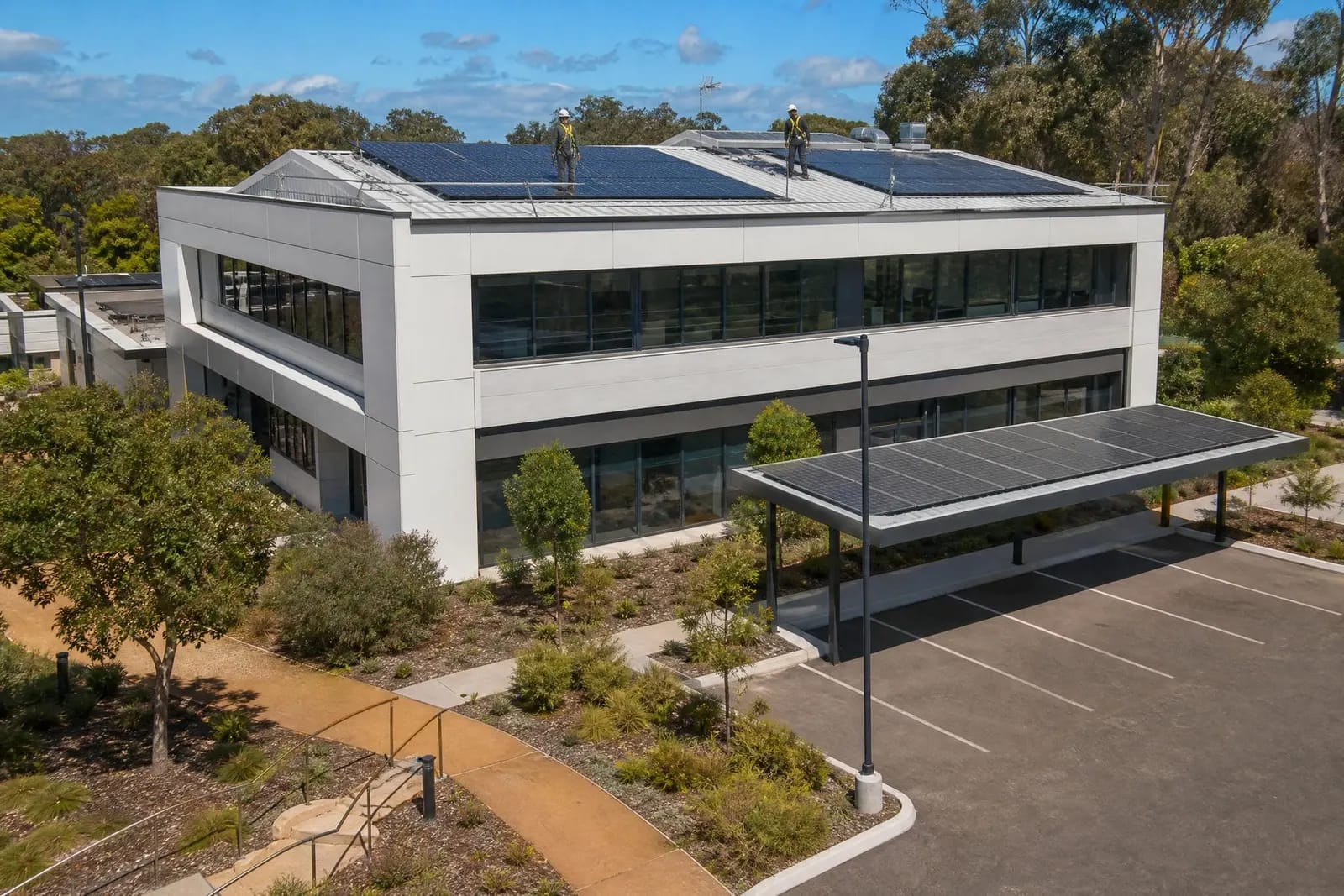
Multi-storey buildings have a small roof for the amount of power they use, so solar often covers only a slice of the bill. A low-rise office park, or a standalone building with a flat roof or carpark, has more room.
Australia
Systems up to 100 kW get small-scale technology certificates (STCs) for the years left until the scheme ends in 2030. Mid-scale systems (100 kW to 1 MW) installed from 1 October 2026 can claim STCs with a fixed 5-year deeming period; the Clean Energy Regulator said applications would not open until mid to late November 2026. Choosing STCs for a mid-scale system means no REGO certificates during the deeming period.
Official detailsVictoria
An upfront incentive, in Victorian energy efficiency certificates created by an accredited person, for 30 to 200 kW solar at grid-connected non-residential premises. It is not available at apartment buildings. It can sit alongside STCs. Systems above 200 kW are not eligible under this activity.
Official detailsNSW
From 1 September 2026, non-residential sites in NSW installing a 20 kWh to 30 MWh battery can get an upfront discount in the installer’s quote: indicatively about 30 to 40 per cent with new or additional solar (installed within 90 days either side), or about 20 to 30 per cent for a battery alone. Batteries of 20 to 200 kWh need a minimum payment. Sign the installer’s nomination form before work starts. Data centres and off-grid sites are excluded. It can be combined with the federal programs if you meet both sets of rules.
Official detailsAustralia
Households and businesses can get STCs for a new battery of 5 to 100 kWh installed with solar of up to 1 MW, but STCs count only the first 50 kWh and taper above 14 kWh. The battery must be on the Clean Energy Council list, installed by an accredited installer with a battery endorsement, and capable of joining a virtual power plant. The per-kWh factor falls in steps: 6.8 until December 2026, then 5.7 from January 2027.
Official detailsAustralia
From 1 July 2026, small businesses with aggregated turnover under $10 million can deduct the full cost of an eligible asset costing under $20,000 in the year it is first used or installed ready for use. Larger systems can go in the small business pool. This is general information: ask your accountant how it applies to you.
Official detailsAn estimate from the Solar Retailers commercial solar calculator, not a quote. A tenant who does not pay the power bill, or who does not own the system, will see a different result.
Business & commercial
How to tell if solar pays off for your business: self-consumption, worked payback examples, NPV and IRR in plain English, and when it is not worth it.

Business & commercial
What commercial solar costs in Australia in 2026, from 10 kW to 100 kW, what the price leaves out, and what drives the cost of systems up to 1 MW.

Business & commercial
What a demand charge is, why solar alone often does not reduce it, and when a battery can. How to read your bill and your meter data first.

Business & commercial
How the $20,000 instant asset write-off, the small business pool and depreciation apply to commercial solar, and what to ask your accountant.

Business & commercial
How to pay for commercial solar: cash, hire purchase, chattel mortgage, lease or solar PPA. What each means, who owns the system, and what to ask a provider.
Checked 31 October 2026. This page is general information, not financial, tax or legal advice. Rules, rebates and prices change, so check the sources before you decide.
Run your own figures first, then ask at least three accredited installers to quote on the same brief. Quotes are free and you’re under no obligation.
Loading…