Skip to content

Commercial solar · Warehouses and factories
Solar for warehouses and factories: big roofs, big daytime loads

Big flat roofs, weekday shifts and refrigeration make these some of the best sites for solar. The things to check are the roof, the network connection and how you are billed, because demand charges can matter as much as energy.
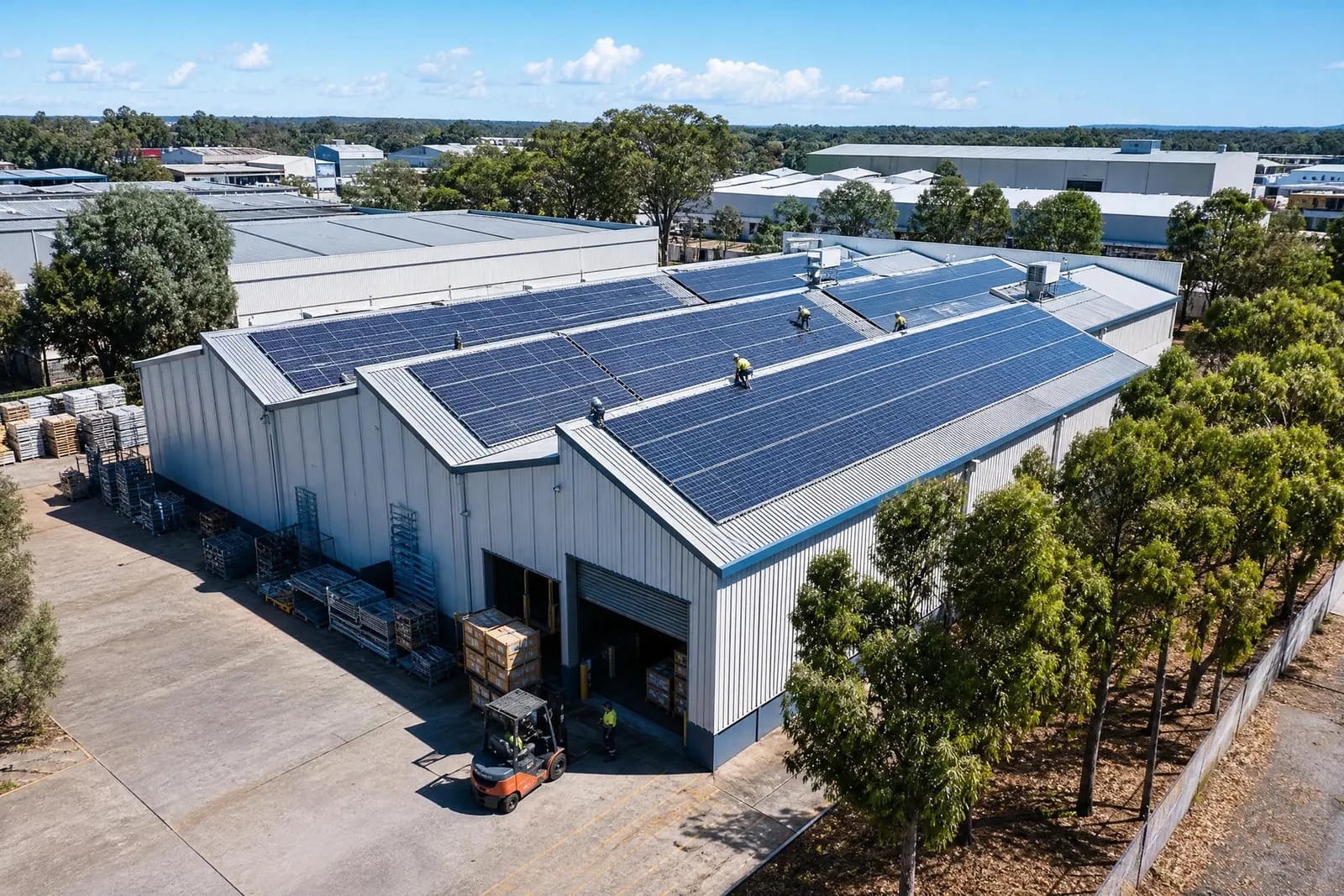
Factory with a sawtooth roof covered in solar panels

The short answer

  • A shift that runs 6am to 6pm on weekdays uses most of its solar on site, which is what makes the numbers work.
  • Systems of 100 kW to 1 MW now have a federal certificate path: STCs with a 5-year deeming period for systems installed from 1 October 2026.
  • Many sites pay a demand charge as well as energy. Solar often does little for the peak, so check your tariff before you count on bill savings.
  • Weekends and shutdowns send the solar to the grid. A cold store or 24-hour process raises the share used on site.
  • Roof age, loading and connection capacity are the usual reasons projects stall, so check them first.

How warehouses and factories use power

A single-shift factory or distribution centre tends to draw most of its power during working hours on weekdays: lighting, machinery, forklift charging, compressors, air conditioning. Solar fits neatly into that window, because output peaks around midday. A multi-shift site or a cold store runs refrigeration around the clock, which raises baseload and means less is exported at weekends.

Weekends and plant shutdowns are the weak spot. If the site is closed for two days a week, those days’ output goes mostly to the grid at a low export price, or is curtailed. A larger system means more of that, so sizing for the weekday load rather than the roof area keeps the return better.

Many industrial tariffs include a demand charge based on your highest half-hour of use in a month, and a cloudy afternoon at start-up can set it. Solar reduces energy use but may not lower the peak, so read the tariff and ask your installer to model both. Our demand charge guide explains how this works.

Typical sizes

Ranges, not recommendations: your bills, roof and network decide the right size.
Up to 100 kW
Small-scale STCs
Fits small units and workshops. The deeming period shortens each year until 2030.
100 kW to 1 MW
Mid-scale STCs
Larger roofs often land here. Installed from 1 October 2026, a fixed 5-year deeming period applies. Applications were due to open in mid to late November 2026.
30 to 200 kW in Victoria
VEU activity 47
Non-residential premises only; above 200 kW this activity does not apply.
Battery 20 kWh to 30 MWh in NSW
NSW business discount
Batteries of 200 kWh or more need no minimum payment. Fire safety standards and a licensed installer apply.
Over 1 MW
No STCs
A system of this size can instead be an accredited power station creating LGCs, which takes more paperwork.

Is it a good fit?

What tends to make it pay

  • Weekday daytime shifts that use most of what the panels make.
  • A cold store, server room or process that runs around the clock and lifts baseload.
  • A large, strong, unshaded roof that is not due for replacement.
  • High daytime energy rates, not a cheap flat rate.
  • Three-phase supply and a transformer with spare capacity.
  • Owner-occupied premises, or a lease long enough to pay the system back.

Sort these out first

  • Check roof age and structure before you invest. Re-roofing later means removing and reinstalling the array.
  • If you lease the premises, the landlord must agree, and the lease should outlast the payback period.
  • Systems above 30 kVA go through a negotiated connection, and the network may limit export or ask for studies and protection equipment. Fees and times differ by network.
  • Demand charges may not fall much. Model them separately, and treat a battery as an option rather than an assumption.
  • Weekend and shutdown exports earn little. Ask for the self-consumption figure and the assumptions behind it.
  • Insurers and fire authorities may have requirements for large rooftop arrays and for batteries. Ask them before you design.
  • Mid-scale certificate applications were due to open only in mid to late November 2026, so check the Clean Energy Regulator for the current position before you sign a contract.

Rebates and programs that can apply

Programs change often, so check the official page before you rely on one. Our guide to commercial solar rebates covers every state.
  • Australia

    Federal STCs for systems up to 1 MW

    Systems up to 100 kW get small-scale technology certificates (STCs) for the years left until the scheme ends in 2030. Mid-scale systems (100 kW to 1 MW) installed from 1 October 2026 can claim STCs with a fixed 5-year deeming period; the Clean Energy Regulator said applications would not open until mid to late November 2026. Choosing STCs for a mid-scale system means no REGO certificates during the deeming period.

    Official details
  • Victoria

    Victorian Energy Upgrades: commercial and industrial solar (activity 47)

    An upfront incentive, in Victorian energy efficiency certificates created by an accredited person, for 30 to 200 kW solar at grid-connected non-residential premises. It is not available at apartment buildings. It can sit alongside STCs. Systems above 200 kW are not eligible under this activity.

    Official details
  • NSW

    NSW business battery discount

    From 1 September 2026, non-residential sites in NSW installing a 20 kWh to 30 MWh battery can get an upfront discount in the installer’s quote: indicatively about 30 to 40 per cent with new or additional solar (installed within 90 days either side), or about 20 to 30 per cent for a battery alone. Batteries of 20 to 200 kWh need a minimum payment. Sign the installer’s nomination form before work starts. Data centres and off-grid sites are excluded. It can be combined with the federal programs if you meet both sets of rules.

    Official details
  • Australia

    Cheaper Home Batteries (federal)

    Households and businesses can get STCs for a new battery of 5 to 100 kWh installed with solar of up to 1 MW, but STCs count only the first 50 kWh and taper above 14 kWh. The battery must be on the Clean Energy Council list, installed by an accredited installer with a battery endorsement, and capable of joining a virtual power plant. The per-kWh factor falls in steps: 6.8 until December 2026, then 5.7 from January 2027.

    Official details
  • Western Australia

    Made in WA Energy Affordability Investment Program

    Low-interest loans of up to $15 million for local manufacturers and other businesses, covering commercial solar and industrial batteries, plus energy-efficient machinery and workforce training. The State Government said it was open for applications on 27 October 2026. No closing date or interest rate was stated.

    Official details
  • Australia

    $20,000 instant asset write-off

    From 1 July 2026, small businesses with aggregated turnover under $10 million can deduct the full cost of an eligible asset costing under $20,000 in the year it is first used or installed ready for use. Larger systems can go in the small business pool. This is general information: ask your accountant how it applies to you.

    Official details

A 150 kW rooftop system on a single-shift warehouse, estimate only

A worked example, so you can see how the numbers fit together. Yours will differ.

Assumptions

  • Weekday site, 6am to 6pm, five days a week, using 250,000 kWh a year, with 25% running around the clock (refrigeration, lighting, standby).
  • Postcode in solar zone 3, installed in November 2026, so mid-scale STCs with a 5-year deeming period at $35 each (the calculator’s default).
  • Installed price $1,000 per kW before certificates, excluding GST. This is an assumption for mid-scale systems, because no public price table covers them.
  • Grid energy at 25 c/kWh excluding GST, exports at 3 c/kWh, prices rising 2.5% a year, panel decline 0.5% a year, maintenance $12 per kW a year.
  • No demand charges, battery, finance, tax or network upgrade costs.

What it works out to

  • Output: about 207,300 kWh in year one, with the model expecting about 74% (about 153,000 kWh) used on site.
  • Cost: $150,000 before certificates. About 1,036 STCs are worth about $36,300 at $35, leaving a net cost of about $113,700.
  • Year-one saving: about $39,900, a simple payback of about 3 years. Over 25 years, the model gives an internal rate of return around 35% and a net present value around $411,000 at a 7% discount rate.
  • These numbers assume every weekday looks the same. Treat them as a starting point and compare with your interval data.
Run your own numbers

An estimate from the Solar Retailers commercial solar calculator, not a quote. It leaves out demand charges, finance, tax and network costs, which can move the result either way.

Questions to ask an installer

Ask every installer the same questions so the quotes compare like for like. More in how to choose a commercial solar installer.
  1. How much of the output do you expect me to use on site on weekdays, weekends and during shutdowns, and what is that based on?
  2. Have you modelled my demand charge, and does the design reduce it?
  3. What has the network said about export limits, studies and protection equipment, and what do they cost?
  4. Have you checked my roof’s age, loading and fire access, and what happens if I re-roof later?
  5. Which certificates will you claim (STCs, or LGCs for larger systems), and who gets the value?
  6. What is your plan for monitoring, cleaning and inverter replacement, and what do those cost over 25 years?
  7. If I add a battery, what will it do for my peak demand and tariff, in numbers?
  8. What do your insurer and the fire authority need for a large rooftop array?

Guides for this decision

Questions

How big can the system be before the rules change?
Up to 100 kW is small-scale and earns STCs for the years left until 2030. From over 100 kW to 1 MW, systems installed from 1 October 2026 can claim STCs with a fixed 5-year deeming period. Over 1 MW, a system can instead be accredited as a power station to create LGCs.
Will solar cut my demand charge?
Not reliably. A demand charge is set by your highest half-hour of use, and clouds or a start-up peak can set it even with solar. Ask your installer to model your tariff and your interval data, and to say how much of the saving comes from energy versus demand.
What if my site shuts down for weeks?
Shutdowns lower the share used on site and the savings. Tell your installer your shutdown calendar, and size for the days you are running, not for the whole roof.
Do I need my landlord’s approval?
If you lease, yes. Check that the lease runs long enough to pay the system back, and who owns the panels at the end. Talk to your lawyer or accountant about the details.

Ready to compare real numbers?

Run your own figures first, then ask at least three accredited installers to quote on the same brief. Quotes are free and you’re under no obligation.