
Business & commercial
Solar and batteries for strata and apartment buildings
How owners corporations can add solar or a battery to common property, what NSW and Victoria offer, and the questions to put to your committee.

Commercial solar · Strata and apartments
The short answer
The common property meter covers the loads that serve the whole building: lifts, corridor and stair lighting, car park lighting and ventilation, pumps, security systems and common-area air conditioning. Many of these run through the night, so the load is fairly flat across the day and week.
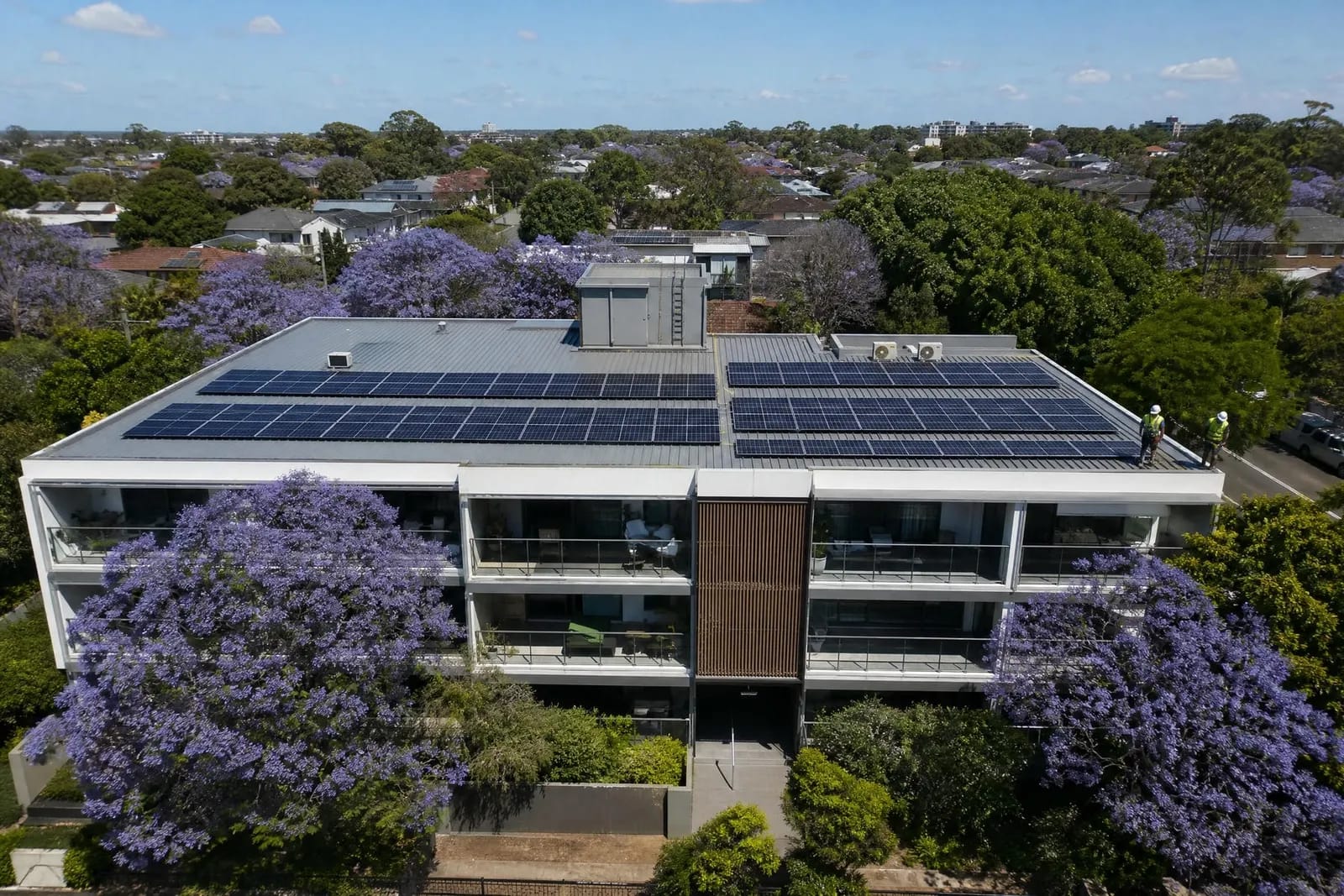
That flat load is good for solar. Because the common property uses power seven days a week, there is less of the weekend gap that hurts offices, and a rooftop array can often be used in full by the building’s own meter. The limit is usually roof space, which is small compared with the number of dwellings, so solar covers only a share of the building’s total use.
Individual apartments have their own meters and bills. Common property solar on its own meter does not reduce those. Systems that feed individual apartments are more complex and depend on how the building is metered, so ask for specific advice. A shared battery on the common property can store daytime solar for the evening peak in lifts and lighting.
NSW
For apartment buildings with at least four units (no upper limit), installing a shared battery of at least 20 kWh and no more than 200 kWh of usable capacity. Available from 1 September 2026, with no current closing date. Owners corporations can use it for shared spaces. The NSW page we read does not state a per-dwelling cap.
Official detailsVictoria
Rebates of up to $2,800 per household for eligible apartments, units and townhouses, paid to eligible owners corporations on behalf of residents. A special resolution is needed to receive funding. The page does not state application dates or whether funding is open, so check before planning around it.
Official detailsAustralia
Households and businesses can get STCs for a new battery of 5 to 100 kWh installed with solar of up to 1 MW, but STCs count only the first 50 kWh and taper above 14 kWh. The battery must be on the Clean Energy Council list, installed by an accredited installer with a battery endorsement, and capable of joining a virtual power plant. The per-kWh factor falls in steps: 6.8 until December 2026, then 5.7 from January 2027.
Official detailsAustralia
Small-scale systems get STCs for the years left until the scheme ends in 2030. Mid-scale systems (100 kW to 1 MW) installed from 1 October 2026 can claim STCs with a 5-year deeming period.
Official detailsAn estimate from the Solar Retailers commercial solar calculator, not a quote. Costs for access, waterproofing, switchboard upgrades and meter changes in apartment buildings can be significant and are not included.
Business & commercial
How owners corporations can add solar or a battery to common property, what NSW and Victoria offer, and the questions to put to your committee.

Business & commercial
How the federal battery discount and NSW business battery discount work for businesses, how to size a battery from interval data, and when one pays off.

Business & commercial
How the NSW business battery discount works from 1 September 2026: size limits, the solar rules, installer requirements and what to ask before you sign.

Business & commercial
The federal solar certificates every business can claim, then what each state and territory offers for commercial solar and batteries as at 31 October 2026.

Business & commercial
What to check on a commercial solar installer, how to write one brief for three quotes, and what every quote should state so you can compare them fairly.
Checked 31 October 2026. This page is general information, not financial, tax or legal advice. Rules, rebates and prices change, so check the sources before you decide.
Run your own figures first, then ask at least three accredited installers to quote on the same brief. Quotes are free and you’re under no obligation.
Loading…