Skip to content

Commercial solar · Shops and cafes

Solar for shops and cafes: fridges, ovens and trading hours

Retail and hospitality sites often use power all day, every day, thanks to fridges and freezers. The tricky parts are small roofs, shared buildings and leases, not the technology.
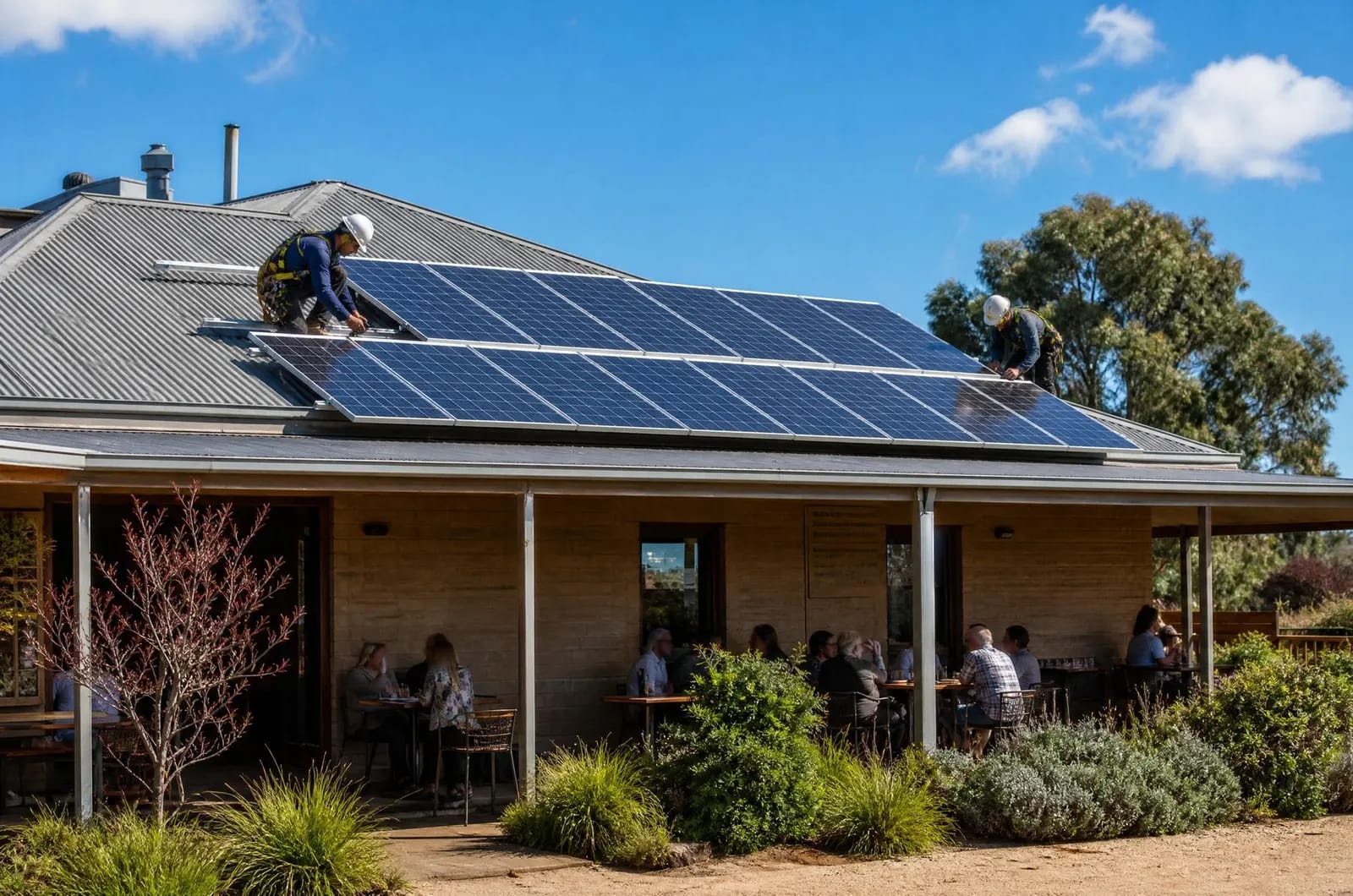
Country town café with solar panels on its iron roof

The short answer

  • Refrigeration runs around the clock, which lifts baseload and means more of the solar is used on site.
  • A small system, often under 30 kW, is typical. Roof space, shading and who controls the roof usually set the size.
  • If you rent, you need the landlord’s agreement and a lease long enough to pay the system back.
  • Evening trade, such as a restaurant or bar, does not line up with the sun, so a battery may be considered but costs a lot.
  • The NSW Government cites a business battery discount of around $37,000 for a grocery store.

How shops and cafes use power

A café or corner store trades seven days a week, and the biggest constant loads are fridges, freezers, display cabinets and hot water. These run overnight too, so a good share of your use is baseload that solar offsets whenever the sun is up. Coffee machines, ovens, dishwashers and air conditioning then add a daytime peak during trading hours.

A morning café that closes at 2pm is almost a perfect match for solar. A restaurant or bar that does most of its trade after dark is not: the sun is gone when the ovens and lights are working hardest. For that kind of site, the daytime fridges still give you a base to work with, but think carefully about how much of your bill is in the evening.

Most small shops have a modest roof, often shared with air-conditioning plant, flues and exhaust fans, and sometimes with a neighbour. Panels have to avoid shade and keep access clear, so the roof, not your bill, often caps the system size.

Typical sizes

Ranges, not recommendations: your bills, roof and network decide the right size.
Up to 30 kW
Small-scale STCs
Most small shops and cafes. STCs apply for the years left until 2030 and fall each year.
30 to 100 kW
Larger stores and supermarkets
In Victoria, 30 to 200 kW at non-residential premises can use VEU activity 47.
Battery from 20 kWh in NSW
NSW business discount
The NSW Government cites a grocery store example of around $37,000 (battery size not stated). Batteries of 20 to 200 kWh need a minimum payment.
Battery 5 to 100 kWh
Federal STCs
Counts only the first 50 kWh and tapers from 14 kWh; needs a VPP-capable, approved battery.

Is it a good fit?

What tends to make it pay

  • Fridges and freezers that run constantly, with daytime trading on top.
  • Seven-day trade, so the solar is used every day.
  • Owning the building, or a long lease and a landlord who agrees.
  • A flat, unshaded roof with space for panels away from plant and flues.
  • An energy rate that is high during the day.

Sort these out first

  • Check who owns the roof. In a strip of shops or a shopping centre, the landlord or owners corporation may control it.
  • Leases that end within a few years may not give you time to pay the system back. Ask who owns the panels at the end.
  • Evening-heavy trade gets less from solar. Look at when your bill is actually incurred before you size the system.
  • Many small shops are on a flat or time-of-use tariff that makes savings smaller than you expect. Use your latest bill, not an average.
  • Roof access, penetrations and flues may mean the array must fit around other equipment.
  • A battery is a large extra cost. Ask for the specific saving it adds, not the total saving of solar plus battery.
  • A very small system may not cover the fixed costs of the installation. Compare quotes for different sizes.

Rebates and programs that can apply

Programs change often, so check the official page before you rely on one. Our guide to commercial solar rebates covers every state.
  • Australia

    Federal STCs for systems up to 1 MW

    Systems up to 100 kW get small-scale technology certificates (STCs) for the years left until the scheme ends in 2030. Mid-scale systems (100 kW to 1 MW) installed from 1 October 2026 can claim STCs with a fixed 5-year deeming period; the Clean Energy Regulator said applications would not open until mid to late November 2026. Choosing STCs for a mid-scale system means no REGO certificates during the deeming period.

    Official details
  • NSW

    NSW business battery discount

    From 1 September 2026, non-residential sites in NSW installing a 20 kWh to 30 MWh battery can get an upfront discount in the installer’s quote: indicatively about 30 to 40 per cent with new or additional solar (installed within 90 days either side), or about 20 to 30 per cent for a battery alone. Batteries of 20 to 200 kWh need a minimum payment. Sign the installer’s nomination form before work starts. Data centres and off-grid sites are excluded. It can be combined with the federal programs if you meet both sets of rules.

    Official details
  • Victoria

    Victorian Energy Upgrades: commercial and industrial solar (activity 47)

    An upfront incentive, in Victorian energy efficiency certificates created by an accredited person, for 30 to 200 kW solar at grid-connected non-residential premises. It is not available at apartment buildings. It can sit alongside STCs. Systems above 200 kW are not eligible under this activity.

    Official details
  • Australia

    Cheaper Home Batteries (federal)

    Households and businesses can get STCs for a new battery of 5 to 100 kWh installed with solar of up to 1 MW, but STCs count only the first 50 kWh and taper above 14 kWh. The battery must be on the Clean Energy Council list, installed by an accredited installer with a battery endorsement, and capable of joining a virtual power plant. The per-kWh factor falls in steps: 6.8 until December 2026, then 5.7 from January 2027.

    Official details
  • Australia

    Discounted finance through the CEFC

    The CEFC does not lend to businesses directly. It funds financiers who pass on lower-cost finance. On 31 July 2026 it announced a program with ANZ for ANZ’s small and medium business customers, with a total discount of 0.8 per cent a year on eligible assets, including rooftop solar and batteries. Apply through ANZ, not the CEFC.

    Official details
  • Australia

    $20,000 instant asset write-off

    From 1 July 2026, small businesses with aggregated turnover under $10 million can deduct the full cost of an eligible asset costing under $20,000 in the year it is first used or installed ready for use. Larger systems can go in the small business pool. This is general information: ask your accountant how it applies to you.

    Official details

A 20 kW system on a seven-day café, estimate only

A worked example, so you can see how the numbers fit together. Yours will differ.

Assumptions

  • Trading seven days a week from 6am to 5pm, using 40,000 kWh a year, with 30% running around the clock (fridges, freezers, hot water).
  • Postcode in solar zone 3, installed in November 2026, so 5 years of small-scale STCs at $35 each (the calculator’s default).
  • Installed price $1,100 per kW before certificates, excluding GST (the calculator’s default for systems up to 30 kW).
  • Grid energy at 25 c/kWh excluding GST, exports at 3 c/kWh, prices rising 2.5% a year, panels declining 0.5% a year, maintenance $12 per kW a year.
  • No battery, finance, tax or demand charges, and no roof strengthening or extra metering.

What it works out to

  • Output: about 27,600 kWh in year one, with the model expecting about 94% (about 26,000 kWh) used on site.
  • Cost: $22,000 before certificates. About 138 STCs are worth about $4,800 at $35, leaving a net cost of about $17,200.
  • Year-one saving: about $6,600, a simple payback of about 2.7 years. Over 25 years, the model gives an internal rate of return around 39% and a net present value around $70,000 at a 7% discount rate.
  • The 94% figure is high because the model assumes every day looks the same. A quiet winter week, or a closed day, will lower it.
Run your own numbers

An estimate from the Solar Retailers commercial solar calculator, not a quote. A real quote for a small system can differ by thousands of dollars.

Questions to ask an installer

Ask every installer the same questions so the quotes compare like for like. More in how to choose a commercial solar installer.
  1. Can you show me the layout on my roof, with shading, flues and access paths marked?
  2. Who owns the roof, and what permission is needed from the landlord or owners corporation?
  3. How much of the output will I use during trading hours, and what does that depend on?
  4. What does the system do during a power outage? Most do nothing unless set up for it.
  5. How is the price split between panels, inverter, installation and certificates, and are STCs passed through in full?
  6. If I add a battery later, can this system take one, and what would change?
  7. What are the warranty terms for panels, inverter and workmanship, and who do I call?

Guides for this decision

Questions

My café opens at 7am and closes at 3pm. Is solar a good match?
Generally yes. Trading hours line up with the sun, and fridges keep running overnight. Check your bill for any evening or overnight peaks, and have the installer base the size on your use rather than your roof.
Can I put solar on a rented shop?
Often yes, with the landlord’s written permission. Ask about the length of your lease, who owns the system at the end, and who is responsible for the roof.
Is a battery worth it for a café?
Only if there is an evening load to cover, and then it depends on cost. NSW has a business battery discount, and the federal program covers businesses. Ask the installer to show what the battery adds, not what the whole system saves.
Can I get a rebate?
Federal STCs reduce the price of any eligible system. In Victoria, 30 to 200 kW at non-residential premises may also get VEU certificates. In NSW, a battery may get a discount. Your quote should show what has been included.

Ready to compare real numbers?

Run your own figures first, then ask at least three accredited installers to quote on the same brief. Quotes are free and you’re under no obligation.