
Skip to content

Commercial solar · Schools and community buildings
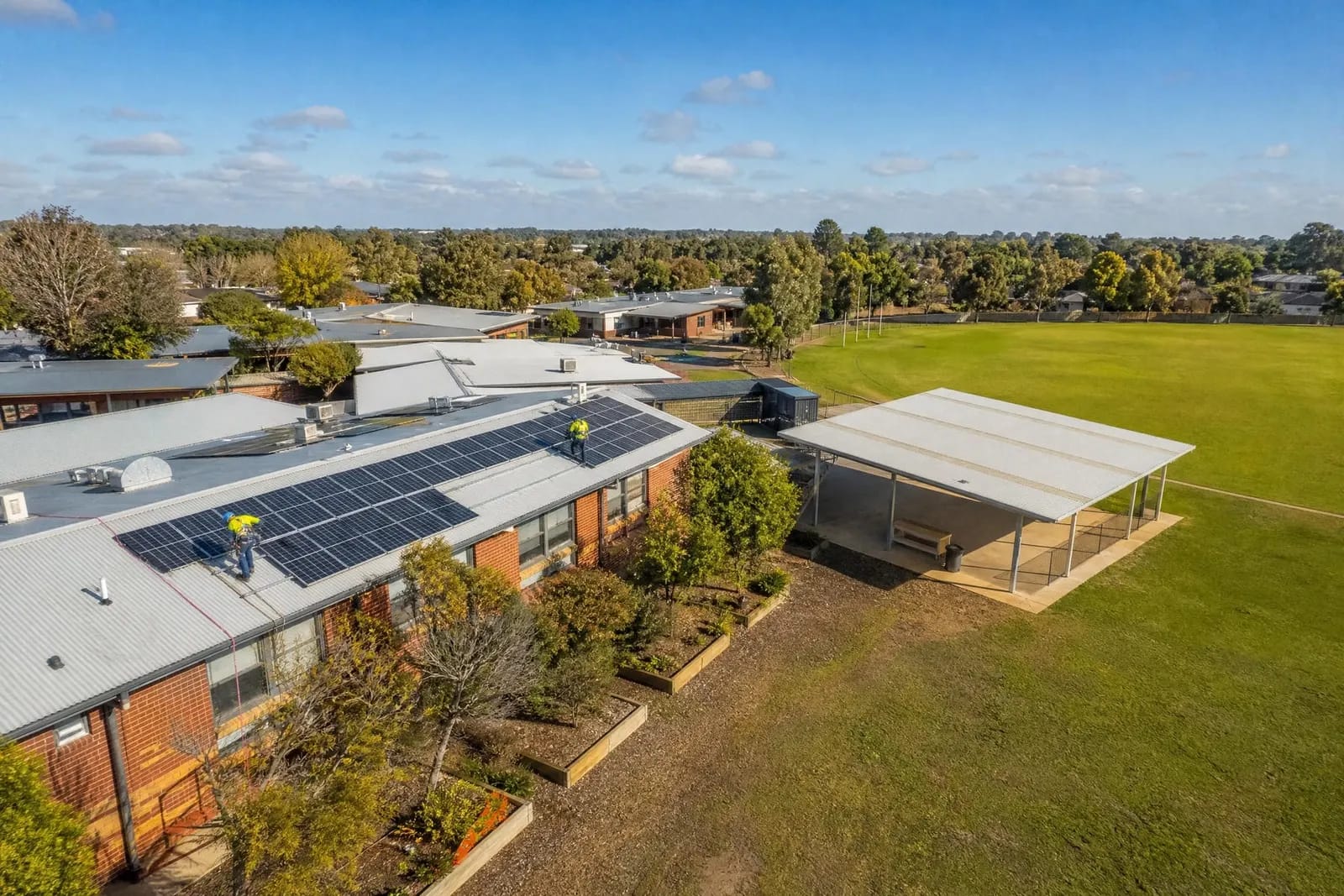
Solar for schools and community buildings: halls, clubs and churches

Schools and community buildings tend to have large roofs, daytime use and long-term owners, which suits solar. Their calendar is the catch: holidays, evenings and weekends change how much power is used on site.
Primary school with solar panels on its classroom roofs

The short answer

  • Schools use most of their power in term time on weekdays, which lines up with the sun, but holidays and the long summer break send solar to the grid.
  • Halls, clubs and churches often use power in bursts: evenings, weekends and events. Solar helps less unless there is a steady daytime use.
  • Solar Victoria says its commercial solar incentive covers community buildings, schools and hospitals.
  • Government schools usually go through their education department, which is a separate process. Independent schools, childcare, halls and clubs can usually decide for themselves.
  • Not-for-profit tax and GST treatment can differ. Ask your accountant.

How schools and community buildings use power

A school runs on weekdays from early morning to mid-afternoon, with lighting, classroom air conditioning, computers, kitchens and, sometimes, a pool or an after-school care program. That is a strong daytime load that suits solar. The weak spots are school holidays, especially the summer break, when the sun is at its strongest and the buildings are almost empty.

Community halls, clubs and churches vary widely. A childcare centre or a community centre with daytime programs is close to a school. A hall used for evening events and weekends will use little power while the sun is up. A sports club with floodlights uses power at night, when solar is not producing.

Whatever the building, check the pattern against your bills month by month. The holiday gap can be large, and the calculator treats every week alike, so a school with long closures should expect a lower share used on site than the model shows.

Typical sizes

Ranges, not recommendations: your bills, roof and network decide the right size.
Up to 100 kW
Small-scale STCs
Most schools, halls and clubs. STCs apply for the years left until 2030 and fall each year.
100 kW to 1 MW
Mid-scale STCs
Large campuses. Installed from 1 October 2026, a fixed 5-year deeming period applies.
30 to 200 kW in Victoria
VEU activity 47
Solar Victoria names community buildings, schools and hospitals as eligible, at non-residential sites.
Battery from 20 kWh in NSW
NSW business discount
Non-residential sites; battery of 20 kWh to 30 MWh. Evening events or floodlights are where a battery might help.

Is it a good fit?

What tends to make it pay

  • Daytime programs on weekdays, such as classes, childcare or community services.
  • Large, simple roofs on a building you own or lease long term.
  • Summer use, such as air conditioning or a pool, that keeps power use up when the sun is strongest.
  • A governing body that can commit to a long payback and has support from the community.
  • Access to a capital fund, a loan, or a rebate to reduce the up-front cost.

Sort these out first

  • Holidays reduce the savings. Ask your installer to model the holiday months, not an average week.
  • Government schools usually can’t sign their own contract. Check with your education department.
  • Roofs on older buildings may have asbestos, weak structure or heritage controls. Check before you design.
  • A hall that is mostly used at night gains little. Look at when your power is actually used.
  • Committees change. Make sure the contract, warranties and maintenance responsibilities survive a change of people.
  • Not-for-profits may have different GST and tax treatment from businesses. Talk to your accountant.
  • Check your insurance, and any approval needed from a parish, diocese, council or trust.

Rebates and programs that can apply

Programs change often, so check the official page before you rely on one. Our guide to commercial solar rebates covers every state.
  • Victoria

    Victorian Energy Upgrades: commercial and industrial solar (activity 47)

    Solar Victoria says all Victorian businesses and non-residential sites are eligible, including community buildings, schools and hospitals, for solar of 30 to 200 kW. The incentive comes as certificates created by an accredited person, and can be combined with STCs. No dollar value is stated on the Solar Victoria page.

    Official details
  • Australia

    Federal STCs for systems up to 1 MW

    Systems up to 100 kW get small-scale technology certificates (STCs) for the years left until the scheme ends in 2030. Mid-scale systems (100 kW to 1 MW) installed from 1 October 2026 can claim STCs with a fixed 5-year deeming period; the Clean Energy Regulator said applications would not open until mid to late November 2026. Choosing STCs for a mid-scale system means no REGO certificates during the deeming period.

    Official details
  • NSW

    NSW business battery discount

    From 1 September 2026, non-residential sites in NSW installing a 20 kWh to 30 MWh battery can get an upfront discount in the installer’s quote: indicatively about 30 to 40 per cent with new or additional solar (installed within 90 days either side), or about 20 to 30 per cent for a battery alone. Batteries of 20 to 200 kWh need a minimum payment. Sign the installer’s nomination form before work starts. Data centres and off-grid sites are excluded. It can be combined with the federal programs if you meet both sets of rules.

    Official details
  • Australia

    Cheaper Home Batteries (federal)

    Households and businesses can get STCs for a new battery of 5 to 100 kWh installed with solar of up to 1 MW, but STCs count only the first 50 kWh and taper above 14 kWh. The battery must be on the Clean Energy Council list, installed by an accredited installer with a battery endorsement, and capable of joining a virtual power plant. The per-kWh factor falls in steps: 6.8 until December 2026, then 5.7 from January 2027.

    Official details
  • ACT

    ACT Sustainable Business Program

    Businesses and organisations operating from commercial premises in the ACT can get rebates of up to $10,000 for energy and water efficiency upgrades, with a co-contribution. The page lists solar and battery storage as an advice topic; check what is covered before you plan around it.

    Official details

A 100 kW system on a school, estimate only

A worked example, so you can see how the numbers fit together. Yours will differ.

Assumptions

  • Monday to Friday, 8am to 4pm, using 160,000 kWh a year, with 15% running around the clock.
  • Postcode in solar zone 3, installed in November 2026, so 5 years of small-scale STCs at $35 each (a system of exactly 100 kW is still small-scale).
  • Installed price $1,050 per kW before certificates, excluding GST (the calculator’s default for 30 to 100 kW).
  • Grid energy at 25 c/kWh excluding GST, exports at 3 c/kWh, prices rising 2.5% a year, panels declining 0.5% a year, maintenance $12 per kW a year.
  • The model treats every week alike. It does not allow for school holidays, which will reduce the share used on site. No battery, finance or tax effects.

What it works out to

  • Output: about 138,200 kWh in year one, with the model expecting about 66% (about 91,800 kWh) used on site.
  • Cost: $105,000 before certificates. About 691 STCs are worth about $24,200 at $35, leaving a net cost of about $80,800.
  • Year-one saving: about $24,300, a simple payback of about 3.5 years. Over 25 years, the model gives an internal rate of return around 30% and a net present value around $237,000 at a 7% discount rate.
  • With long holiday closures, the real share used on site will be lower than 66%, so expect a smaller saving and a longer payback.
Run your own numbers

An estimate from the Solar Retailers commercial solar calculator, not a quote. It does not model holiday closures, so a school should adjust the self-consumption figure to match its own data.

Questions to ask an installer

Ask every installer the same questions so the quotes compare like for like. More in how to choose a commercial solar installer.
  1. Have you worked with schools or community groups, and do you understand the approval process?
  2. How have you accounted for school holidays and weekends in your self-consumption estimate?
  3. Have you checked the roof for asbestos, structure and any heritage or planning controls?
  4. What paperwork do we need from our governing body, education department or trustees?
  5. How will you manage site safety around children, including working hours and access?
  6. Could the system support a battery or backup later, such as for a community refuge, and what would change?
  7. Which certificates or incentives do you claim, and how is the value passed on in the price?
  8. What are the maintenance and monitoring arrangements, and who do we call in five years?

Guides for this decision

Questions

Can a school use the Victorian business solar incentive?
Solar Victoria says community buildings, schools and hospitals are eligible under its commercial and industrial solar incentive, for systems of 30 to 200 kW at non-residential sites. Government schools typically go through their education department.
What happens in the school holidays?
Output continues but use falls, so more goes to the grid at a low export price. Ask for an estimate that includes the holiday months.
Is solar worth it for a hall that is used mostly in the evening?
Often less. Look at your daytime use first. A battery could shift solar into the evening but costs a lot, so ask for the specific saving it would add.
Is there help with the up-front cost?
Federal STCs reduce the price of eligible systems. Depending on where you are, a state program or finance may help; see the programs above and the finance guide. Talk to your accountant about the tax and GST position of your organisation.

Ready to compare real numbers?

Run your own figures first, then ask at least three accredited installers to quote on the same brief. Quotes are free and you’re under no obligation.