
Commercial solar by size
200 kW solar system: cost, output and payback (2026)
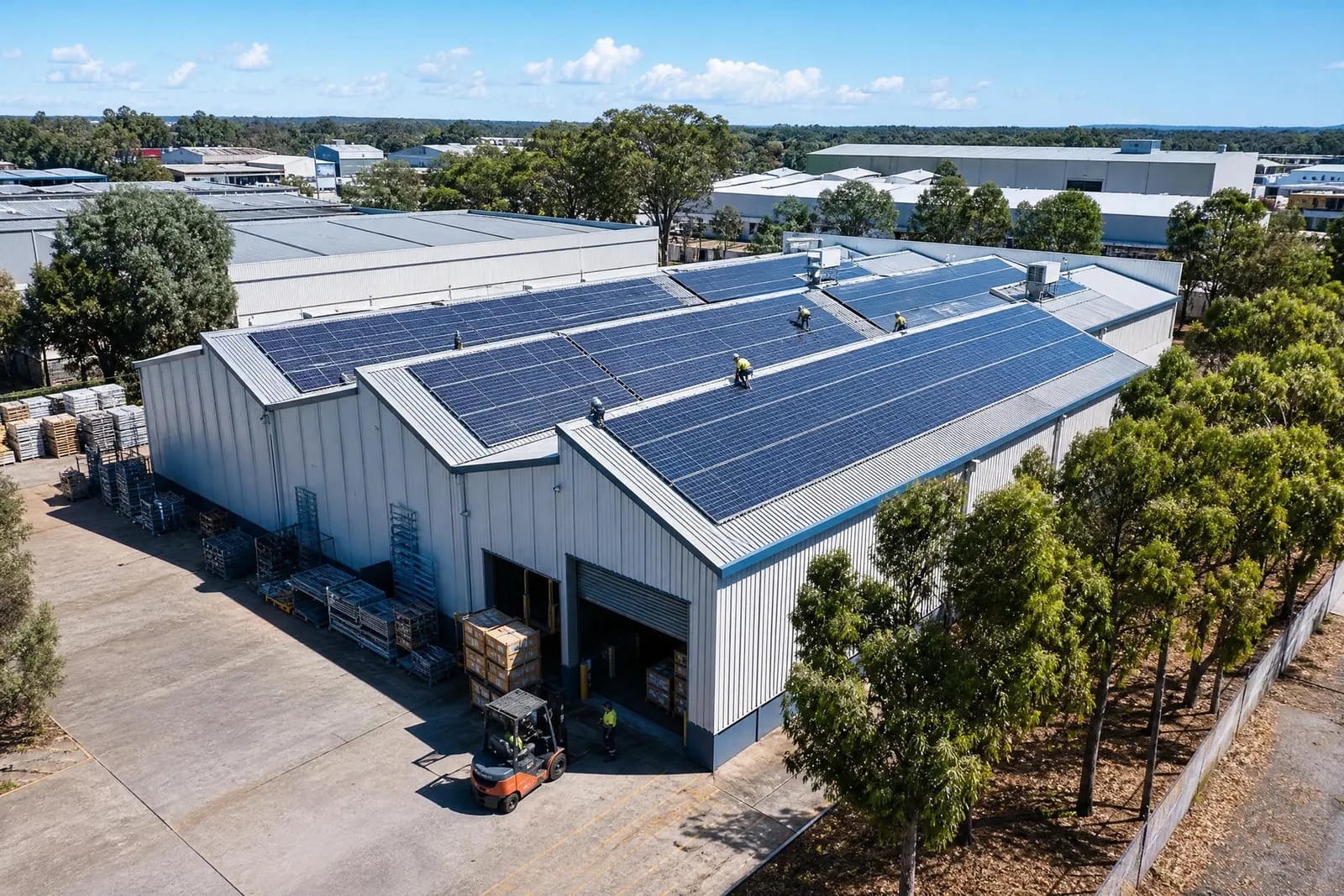
200 kW at a glance
- Panels
- about 455
- at 440 W each (assumed)
- Panel area
- about 1,001 m²
- at 2.2 m² a panel, before access paths
- Output
- 237 to 307 MWh a year
- across the eight capital cities
- Certificates
- mid-scale STCs
- fixed 5-year deeming from 1 Oct 2026
What does a 200 kW system cost?
| City | STCs (est.) | Estimated price |
|---|---|---|
| Sydney | 1,382 | $166,793 |
| Melbourne | 1,185 | $174,378 |
| Brisbane | 1,382 | $166,793 |
| Adelaide | 1,382 | $166,793 |
| Perth | 1,382 | $166,793 |
| Hobart | 1,185 | $174,378 |
| Canberra | 1,382 | $166,793 |
| Darwin | 1,536 | $160,864 |
These ignore metering, ground-mounting, grid studies and any network upgrades, and assume the 100 kW price per kW holds at this size, which may not be true. Edit the price per kW in the calculator to match real quotes.
How much does 200 kW make in each capital?
| City | Postcode | Zone (rating) | kWh a year | Certificates |
|---|---|---|---|---|
| Sydney | 2000 | 3 (1.382) | 276,400 | 1,382 |
| Melbourne | 3000 | 4 (1.185) | 237,000 | 1,185 |
| Brisbane | 4000 | 3 (1.382) | 276,400 | 1,382 |
| Adelaide | 5000 | 3 (1.382) | 276,400 | 1,382 |
| Perth | 6000 | 3 (1.382) | 276,400 | 1,382 |
| Hobart | 7000 | 4 (1.185) | 237,000 | 1,185 |
| Canberra | 2600 | 3 (1.382) | 276,400 | 1,382 |
| Darwin | 0800 | 2 (1.536) | 307,200 | 1,536 |
Certificates assume installation on 1 November 2026. Rating in MWh per kW per year.
Panels and roof
- You need more roof than the panel area: walkways for maintenance, setbacks from edges, and gaps between rows if the panels are tilted on a flat roof.
- The roof must carry the load. Older or sheet-metal roofs may need a structural engineer’s report, and asbestos roofs are a separate problem to solve first.
- Your installer’s panel size will differ from our assumption, so the panel count will too. Ask for the layout drawing.
Which certificates does it get, and why?
Mid-scale systems (over 100 kW up to 1 MW) installed on or after 1 October 2026 get a fixed 5-year deeming period, whatever the year. Before that date they could not create STCs at all. We assume the same sum as the small-scale scheme, with 5 years: in Sydney that is 1,382 certificates. Check the figure with the Clean Energy Regulator’s mid-scale calculator.
- The Clean Energy Regulator says applications for mid-scale STCs open in mid to late November 2026.
- Eligibility depends on the installation date, which is when the system was first able to produce and deliver electricity.
- You need evidence of planning and building approvals, and network connection approval where it applies, plus the panels’ serial numbers.
- If you take STCs you can’t also create REGO certificates during the deeming period.
Try your own postcode and date in the STC calculator, and read our guide to mid-scale STCs.
Network approval
Systems over about 30 kW usually need the local network’s approval before they are switched on, and sometimes studies, protection equipment or limits on how much you can export. That can add cost and weeks or months. Mid-scale STC applications also need evidence of the network’s approval.
Start the application early, and ask each installer who pays for studies and what happens if the network says no. Read our guide to grid connection.
A worked payback example
- Output in year 1
- 276,400 kWh
- Used on site (modelled)
- 75%
- Saving in year 1
- $53,942
- Installed price
- $200,000 excluding GST
- Certificates (mid-scale STCs)
- 1,382 worth $48,370
- Net cost
- $151,630
- Simple payback
- 2.9 years
- 25-year NPV at 7%
- $559,368
- IRR
- 35.8%
- Cost per kWh over its life
- 6.1c
Assumptions in this example
- Electricity rate avoided: 25 c/kWh excluding GST, rising 2.5% a year.
- Export rate: 3 c/kWh, held flat.
- Installed price: $1,000 per kW before certificates, excluding GST.
- Certificates at $35 each; installed 1 November 2026.
- Output falls 0.5% a year; maintenance $12 per kW a year, rising with prices; 25 years.
- Discount rate 7%.
- Not included: demand charges, batteries, finance costs, tax and depreciation, network costs, inverter replacement.
Questions about 200 kW systems
- How much does a 200 kW commercial solar system cost?
- There is no public price table for systems this size. Our estimate assumes about $1,000 per kW before certificates (excluding GST), which is about $200,000 for 200 kW, less about $48,370 of mid-scale STCs. Real quotes vary a lot with the roof, the network and the site, so treat it as a starting point and get several.
- How much electricity does a 200 kW system make?
- About 237,000 to 307,200 kWh a year, depending on the city, using the Clean Energy Regulator’s zone ratings (size × rating × 1,000). In Sydney that is 276,400 kWh. Real output varies with shade, tilt, orientation and dirt.
- Does a 200 kW system get the solar rebate?
- From 1 October 2026, yes: systems over 100 kW and up to 1 MW can earn STCs with a fixed 5-year deeming period. That is about 1,382 certificates in Sydney, worth roughly $48,370 at $35 each. Applications are expected to open in mid to late November 2026.
- How many panels and how much roof does 200 kW need?
- About 455 panels at 440 W each, covering roughly 1,001 square metres of panel area. You need more roof than that for access paths, edge setbacks and tilt-frame spacing, and the roof must be strong enough and not heavily shaded.
- Is a 200 kW system the right size for my business?
- It often suits a large warehouse, a manufacturing site, or a school or council depot with several roofs. The right size depends on how much power you use in daylight, not how much roof you have. The usual mistake is a system bigger than your daytime use, which exports surplus at a low rate. Run your numbers in the calculator.
- When is solar not worth it for a business?
- When you rent with a short lease, plan to move, mostly use power at night, have a shaded, fragile or asbestos roof, or can’t get the network’s approval to connect. In those cases, ask about energy efficiency first, or a lease with the landlord’s agreement.
Sources
- Solar Choice: commercial solar pricing (September 2026)
- Clean Energy Regulator: transitional guidance for mid-scale solar (PV) systems
- Clean Energy Regulator: postcode zone ratings
- Clean Energy Regulator: deeming period decline
- Clean Energy Regulator: large-scale generation certificates
Checked 31 October 2026. This page is general information, not financial, tax or legal advice. Rules, rebates and prices change, so check the sources before you decide.
Ready to compare real numbers?
Run your own figures first, then ask at least three accredited installers to quote on the same brief. Quotes are free and you’re under no obligation.